
January 26, 2026
10 min read
Most people think delegation means handing off tasks. It doesn't. That's just offloading work. Real delegation is about transferring capability.
The difference is profound. When you delegate a task, you get one thing done. When you delegate capability, you multiply your capacity permanently.
But most leaders never get there. They stay stuck at the first level, wondering why they're still the bottleneck.
The Three Layers of Delegation
Delegation isn't binary. It's a progression through three distinct layers, each requiring different skills and yielding different returns.
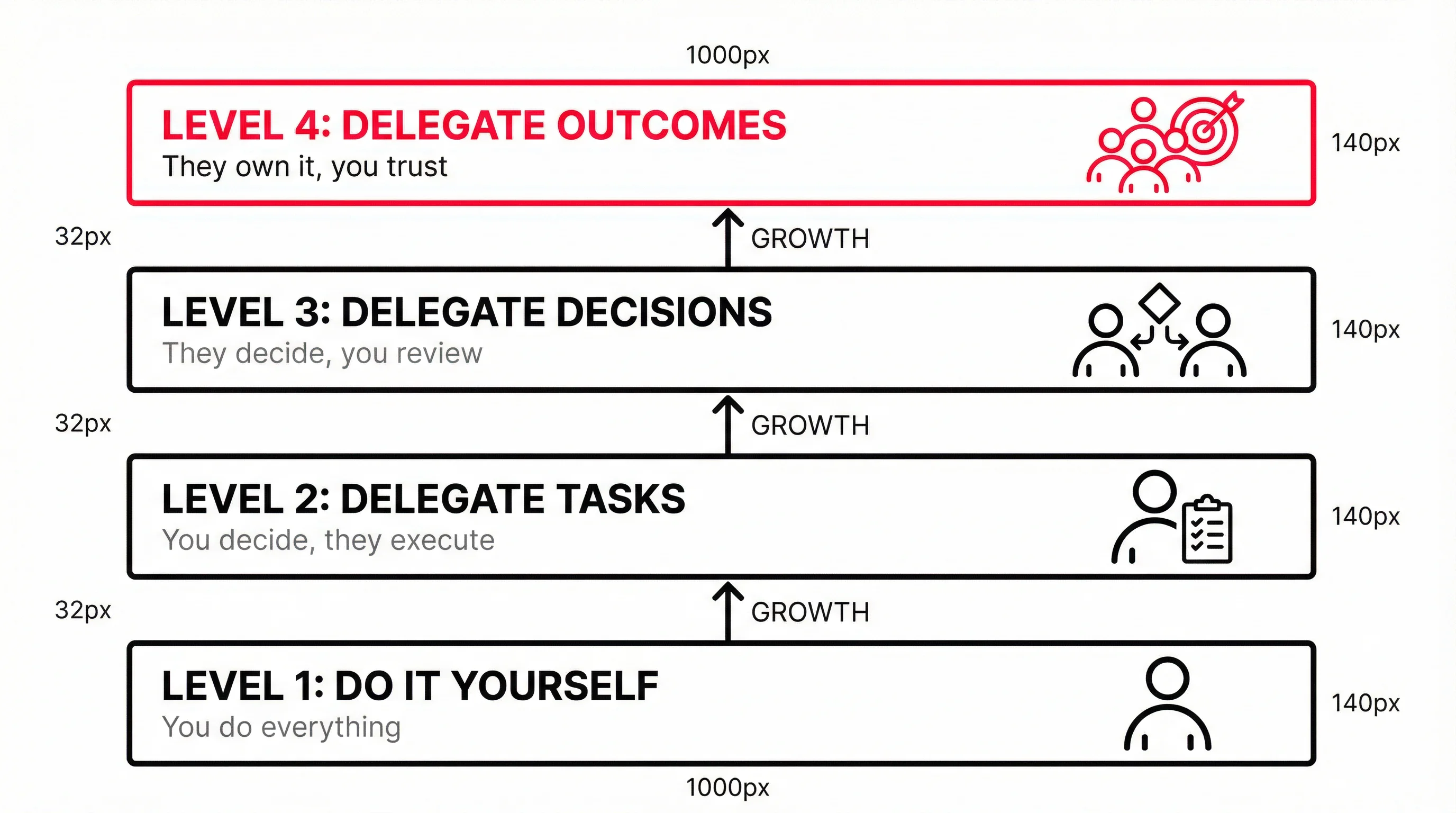
Layer 1: Task Delegation — "Do this specific thing." You hand off a defined piece of work. The person executes. You check the result. This is where most people stop.
Layer 2: Process Delegation — "Follow this system." You transfer not just the task, but the method. The person can now handle variations of the same work without constant guidance.
Layer 3: Outcome Delegation — "Achieve this result." You define the goal, not the method. The person owns the problem, develops their own approach, and takes responsibility for the outcome.
Each layer multiplies your capacity. But each requires more trust, better systems, and clearer communication.
The Trust-Verification Matrix
Here's where most delegation fails: people confuse trust with verification. They think if you trust someone, you don't need to verify. Or if you verify, you don't trust them.
Both are wrong.
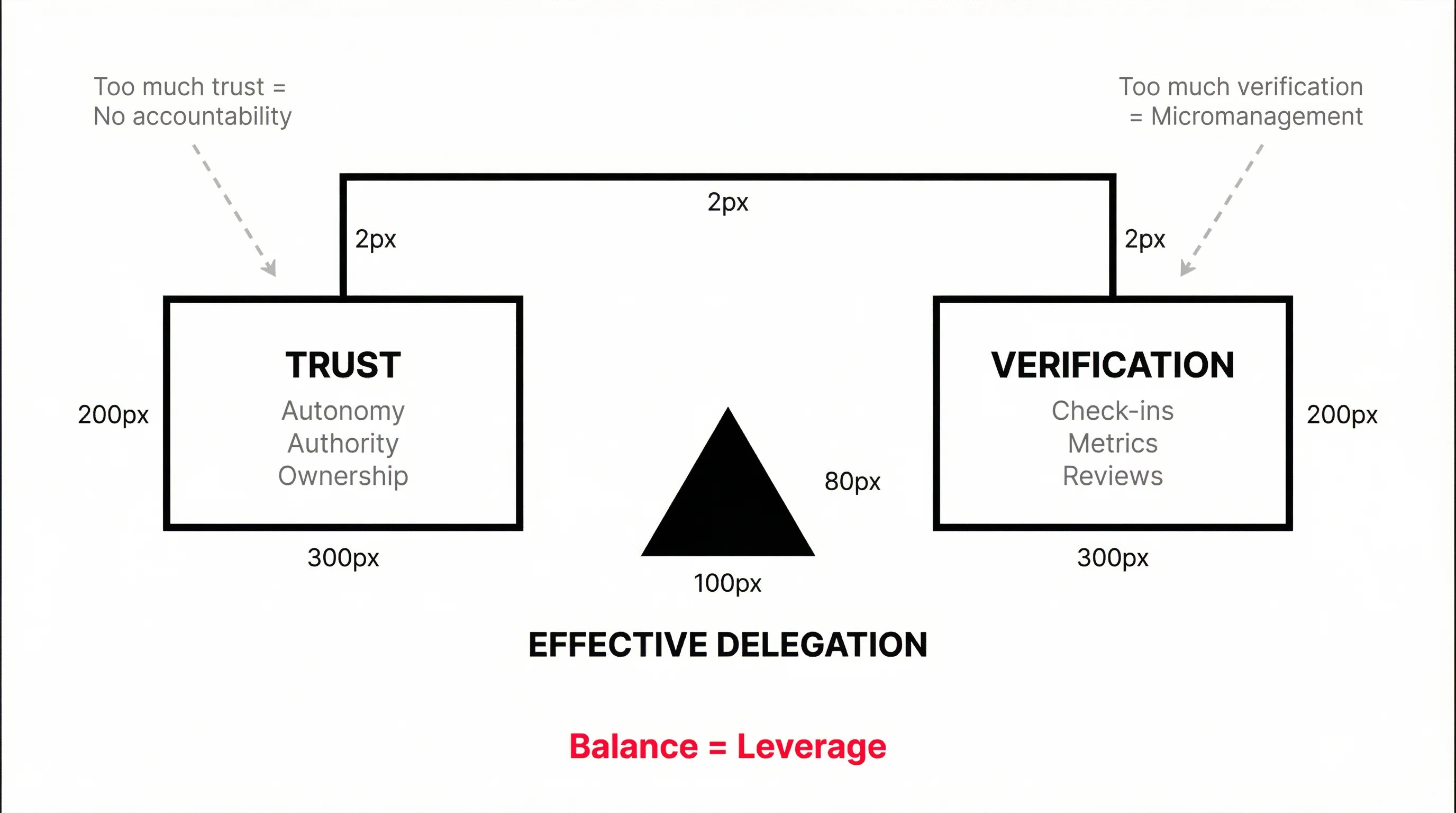
- →Low Trust + Low Verification = Abdication. You hand off work and hope for the best. This isn't delegation, it's gambling.
- →Low Trust + High Verification = Micromanagement. You check everything because you don't believe they can do it. This destroys autonomy and wastes your time.
- →High Trust + Low Verification = Blind Faith. You trust them completely and never check. This works until it doesn't, and when it fails, it fails catastrophically.
- →High Trust + High Verification = Sustainable Delegation. You trust their capability and verify through systems, not surveillance.
"The goal isn't to eliminate verification. It's to make verification automatic, embedded in the process itself."
System Extraction
The bottleneck in delegation isn't finding good people. It's extracting the system from your head.
Most of what you do isn't documented. It's intuition, pattern recognition, accumulated experience. You make a hundred micro-decisions without thinking. Then you try to delegate and realize you can't explain what you actually do.
This is why delegation feels hard. You're trying to transfer something you haven't fully articulated to yourself.
The solution: system extraction. Before you delegate, document the process. Not a manual, a system. The decision points, the edge cases, the "it depends" moments. Turn your intuition into explicit rules.
This takes time upfront. But it's the only way to move from task delegation to outcome delegation. Once the system exists outside your head, others can run it, improve it, and own it.
The Delegation Paradox
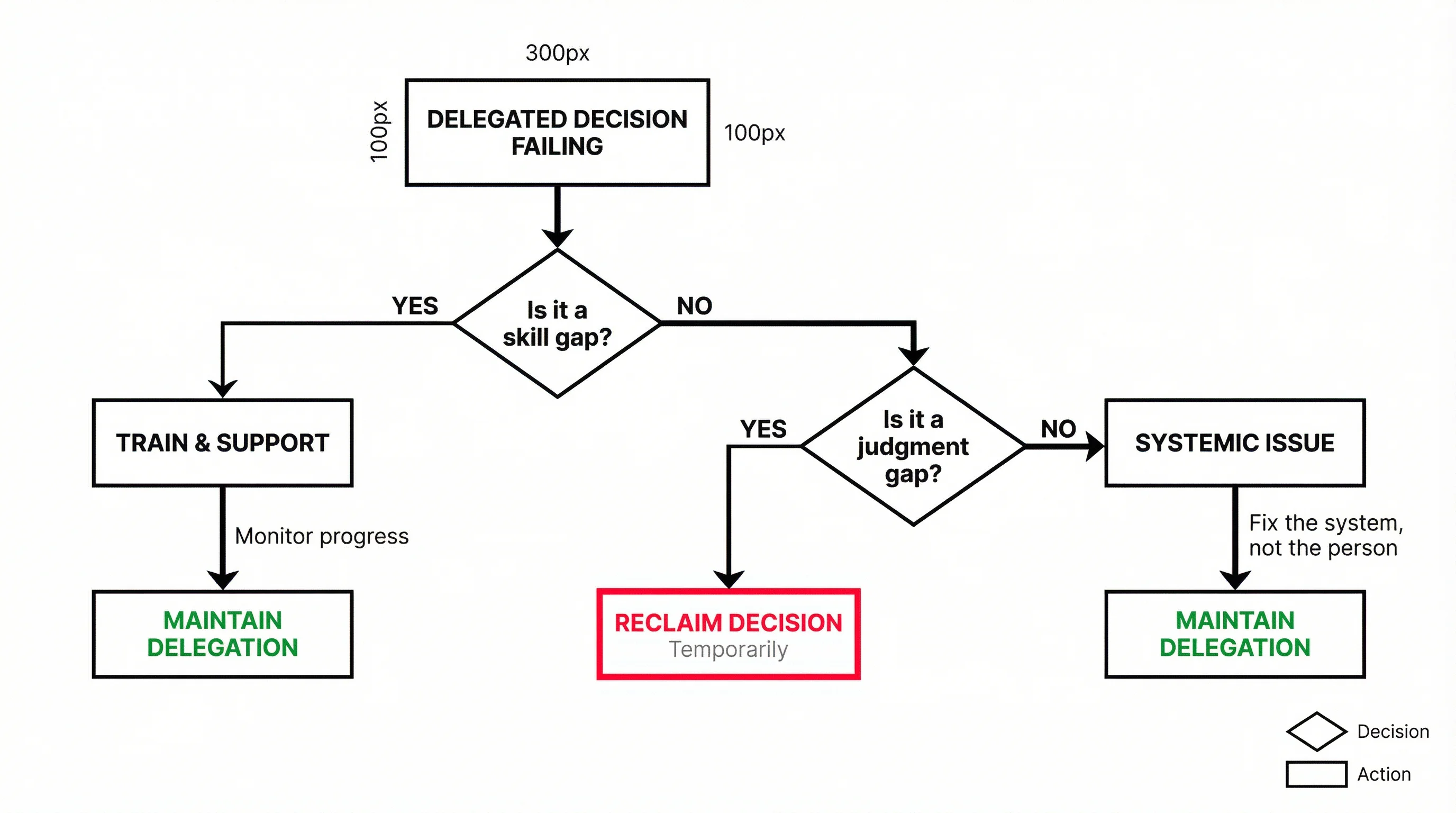
Here's the paradox: the more capable you are, the harder it is to delegate.
Because you can do it faster yourself. You can see the solution immediately. You know exactly how it should be done. So you keep doing it.
This is a trap. Every time you do something you could delegate, you're choosing short-term efficiency over long-term capacity. You're optimizing for today at the expense of tomorrow.
"If you'll do it more than twice, delegate it."
Yes, it takes longer the first time. Yes, the quality might be lower initially. But the second time is faster. The third time is automatic. And by the tenth time, you've created capacity you didn't have before.
Delegation isn't about saving time today. It's about creating leverage forever.
What This Means
Most delegation advice focuses on the mechanics: how to give clear instructions, how to follow up, how to provide feedback. That's useful, but it misses the point.
The real work of delegation is building systems that enable others to make good decisions without you. It's extracting your intuition and encoding it into processes. It's creating feedback loops that verify without micromanaging.
When you do this right, delegation stops being a management task and becomes organizational leverage. You're not just freeing up your time. You're multiplying your capability across the entire team.
That's the art of delegation. Not handing off work. Building systems that enable others to own outcomes.