
Static agents are tools. Self-evolving agents are teammates that get better every day.
The Static Agent Problem
Most AI agents are frozen in time. They're deployed with a fixed configuration and never change. When they make mistakes, humans have to manually update them.
This doesn't scale. You can't manually tune hundreds of agents. You need agents that **learn from their mistakes** and **improve themselves**.
The paper "EvoConfig: Self-Evolving Multi-Agent Systems" introduces a framework for autonomous agent evolution. Agents that debug themselves, optimize themselves, and get smarter over time.
The Three Levels of Evolution
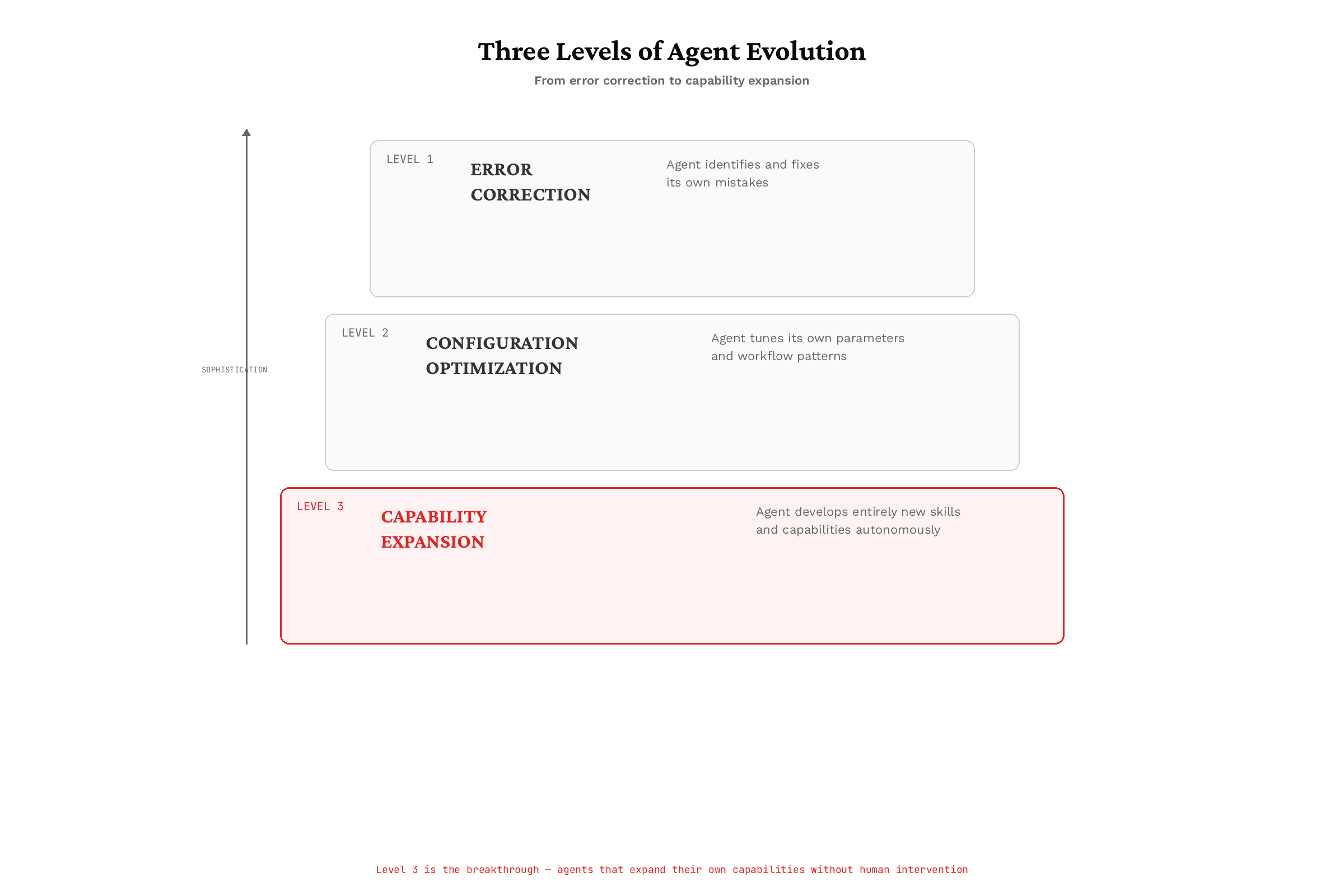
Level 1: Error Correction
The agent detects when it makes a mistake and fixes it **during execution**.
Example: Agent tries to call an API with wrong parameters. Gets error. Analyzes error message. Adjusts parameters. Retries successfully.
This is **tactical evolution**—fixing immediate problems without human intervention.
Level 2: Configuration Optimization
The agent analyzes its performance and adjusts its configuration **between executions**.
Example: Agent notices it's using too many API calls for simple tasks. Adjusts its prompts to be more efficient. Reduces cost by 40%.
This is **strategic evolution**—improving efficiency based on patterns.
Level 3: Capability Expansion
The agent identifies gaps in its abilities and **teaches itself new skills**.
Example: Agent encounters a task it can't handle. Searches for relevant tools or APIs. Integrates them. Now handles that task type.
This is **transformational evolution**—expanding capabilities autonomously.
The EvoConfig Framework
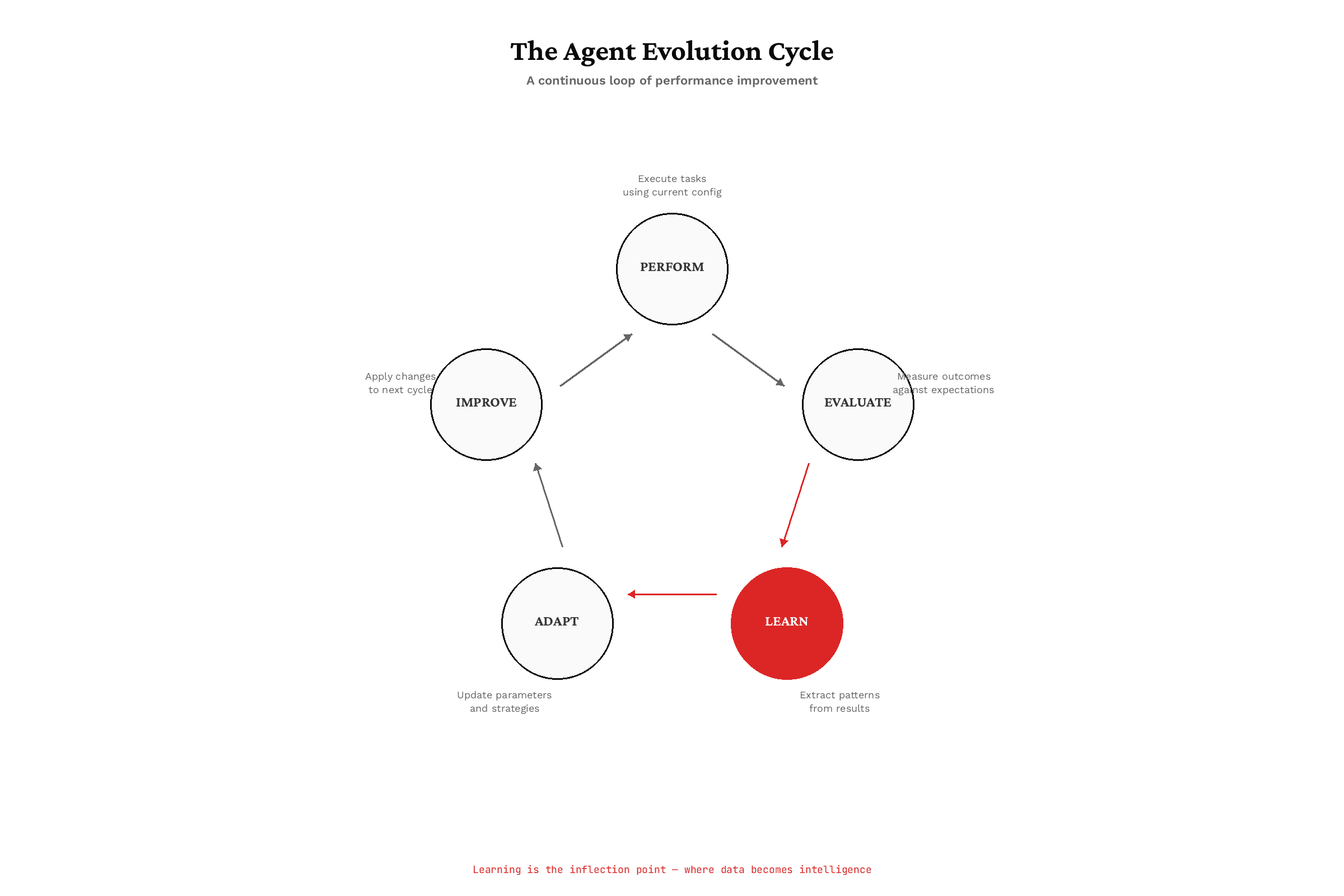
EvoConfig provides the infrastructure for self-evolution. Here's how it works:
Error Detection
Agent monitors its own execution. Detects failures, inefficiencies, and anomalies in real-time.
Root Cause Analysis
Agent analyzes why the error occurred. Was it bad configuration? Missing capability? External API change?
Solution Generation
Agent generates potential fixes. Simulates them in a sandbox environment. Selects the best solution.
Safe Deployment
Agent applies the fix in a controlled way. Monitors impact. Rolls back if it makes things worse.
Knowledge Retention
Agent stores what it learned in long-term memory. Next time it encounters a similar problem, it already knows the solution.
How Oracle Uses Self-Evolution
Oracle, ArmadaOS's learning agent, is built on EvoConfig principles. Here's what it does:
Learns from Failures
When Oracle makes a mistake, it doesn't just log it—it analyzes why, generates a fix, and updates itself. The same mistake never happens twice.
Optimizes Performance
Oracle monitors its resource usage and adjusts its behavior to be more efficient. It learns which approaches work best for which tasks.
Expands Capabilities
When Oracle encounters a task it can't handle, it searches for tools or patterns that could help. It integrates new capabilities autonomously.
Shares Knowledge
What Oracle learns, other agents can use. The system gets smarter collectively, not just individually.
The Phased Autonomy Model
Self-evolution doesn't mean agents do whatever they want. Oracle uses **phased autonomy**:
Phase 1: Supervised Evolution
Agent proposes changes. Human approves. Agent learns what humans approve.
Phase 2: Conditional Autonomy
Agent makes small, low-risk changes autonomously. Escalates big changes to humans.
Phase 3: Full Autonomy
Agent evolves freely within its contract boundaries. Humans audit periodically.
You control how much autonomy each agent has. Start conservative, expand as trust builds.
The Compound Effect
Self-evolution creates a compounding effect:
Week 1
Agent makes mistakes and learns from them. Slightly better than deployment.
Month 1
Agent has seen most common errors. Handles them automatically. Significantly better.
Month 6
Agent has optimized its configuration. Expanded its capabilities. Operates at expert level.
Year 1
Agent is unrecognizable from its initial deployment. It's learned patterns you didn't know existed. It's better than the humans who built it.
This is the difference between a tool and an intelligence. Tools are static. Intelligences compound.
Frequently Asked Questions
Is self-evolution safe?
With proper constraints, yes. Agents evolve **within their contracts**. They can't violate resource limits, access controls, or safety policies. Evolution is bounded.
How do I control what agents learn?
Through phased autonomy. Start with supervised evolution where you approve all changes. Gradually increase autonomy as the agent proves itself. You're always in control.
Can agents unlearn bad behaviors?
Yes. If an agent learns something wrong, you can roll back its configuration or explicitly mark certain patterns as incorrect. The agent updates its knowledge accordingly.
How fast do agents improve?
Depends on error frequency. Agents that encounter many edge cases learn faster. Typical improvement: 20-30% efficiency gain in first month, 50-70% by month six.
Do agents share what they learn?
In ArmadaOS, yes. Agents can share knowledge through the MCP layer. What one agent learns, others can benefit from. Collective intelligence.
What if an agent evolves in the wrong direction?
Rollback. Every evolution step is versioned. You can revert to any previous configuration. Plus, contracts prevent catastrophic changes—agents can't evolve outside their boundaries.
Implementing Self-Evolution
To add self-evolution to your agents:
Add Error Detection
Instrument your agents to detect failures, inefficiencies, and anomalies. Log everything.
Build Sandbox Environment
Create a safe space where agents can test changes without affecting production. Isolated, instrumented, fast.
Implement Configuration Versioning
Every agent configuration is versioned. You can see what changed, when, and why. Rollback is one click.
Start with Supervised Mode
Agents propose changes, you approve. This builds trust and trains the agent on what you value.
Gradually Increase Autonomy
As agents prove themselves, expand their autonomy. Let them make small changes automatically. Monitor closely.
Source Research
This analysis is based on the paper "EvoConfig: Self-Evolving Multi-Agent Systems" published on arXiv.
Read Full Paper →