
Most multi-agent systems fail in predictable ways. This study analyzed 42,000 commits to find the patterns.
The Largest Study of Multi-Agent Systems
Researchers analyzed **42,000 commits** across hundreds of multi-agent system projects. They looked at:
- What bugs occur most frequently
- What causes system failures
- What patterns lead to success
- What mistakes are repeated across projects
The paper "Large-Scale Study of Multi-Agent Systems Development" documents the findings. This is the empirical data you need to avoid common pitfalls.
The Top 10 Failure Modes
These are the most common ways multi-agent systems break in production:
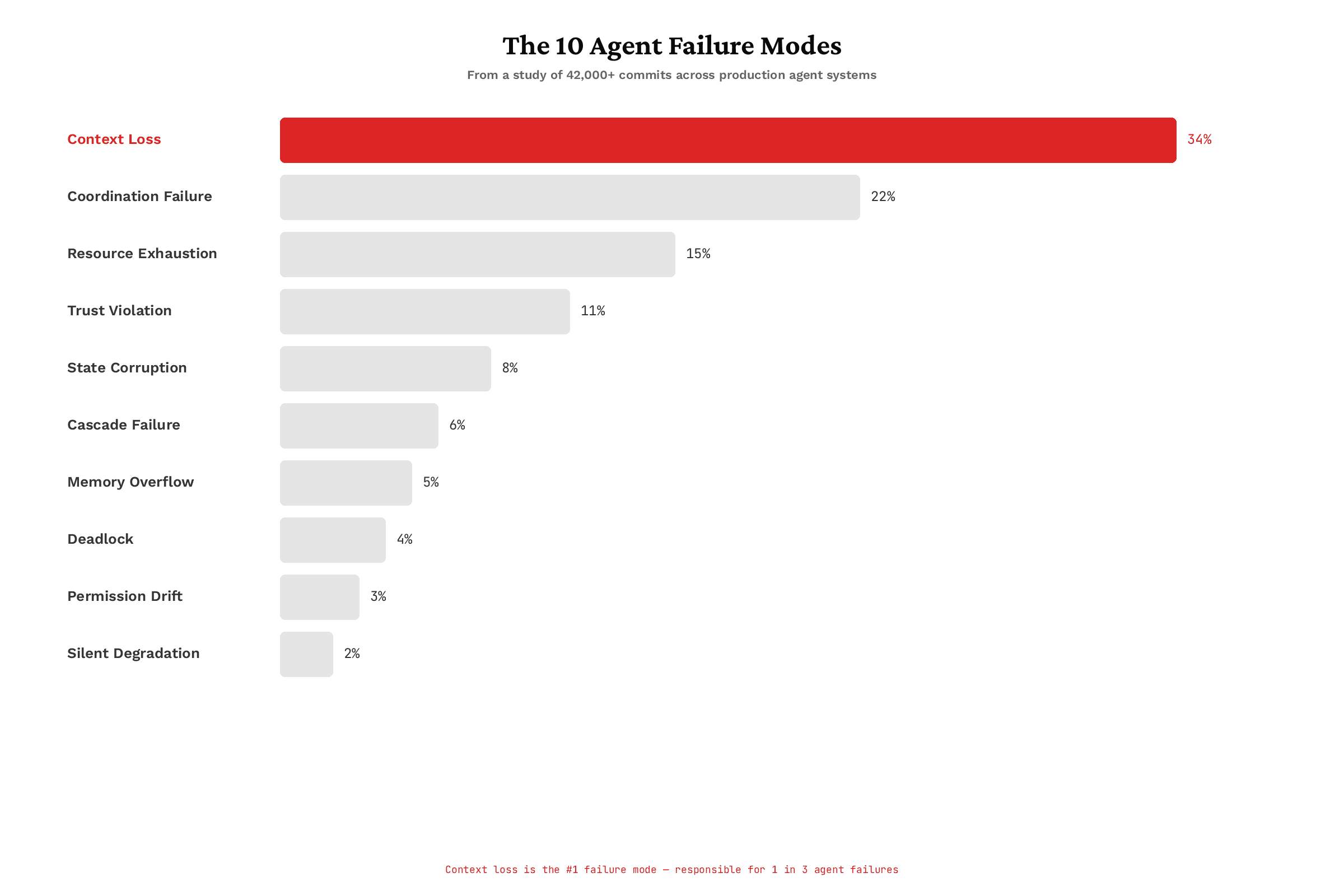
Resource Exhaustion
Agents consume all available resources (API calls, memory, compute) and crash the system.
**Prevention:** Implement resource contracts with hard limits.
Coordination Deadlock
Agents wait for each other in a circular dependency. System freezes.
**Prevention:** Use timeout-based coordination with fallback paths.
State Inconsistency
Agents have different views of system state. Decisions conflict.
**Prevention:** Centralized state management with MCP.
Message Loss
Agent-to-agent messages get dropped. Tasks never complete.
**Prevention:** Reliable message queues with acknowledgments.
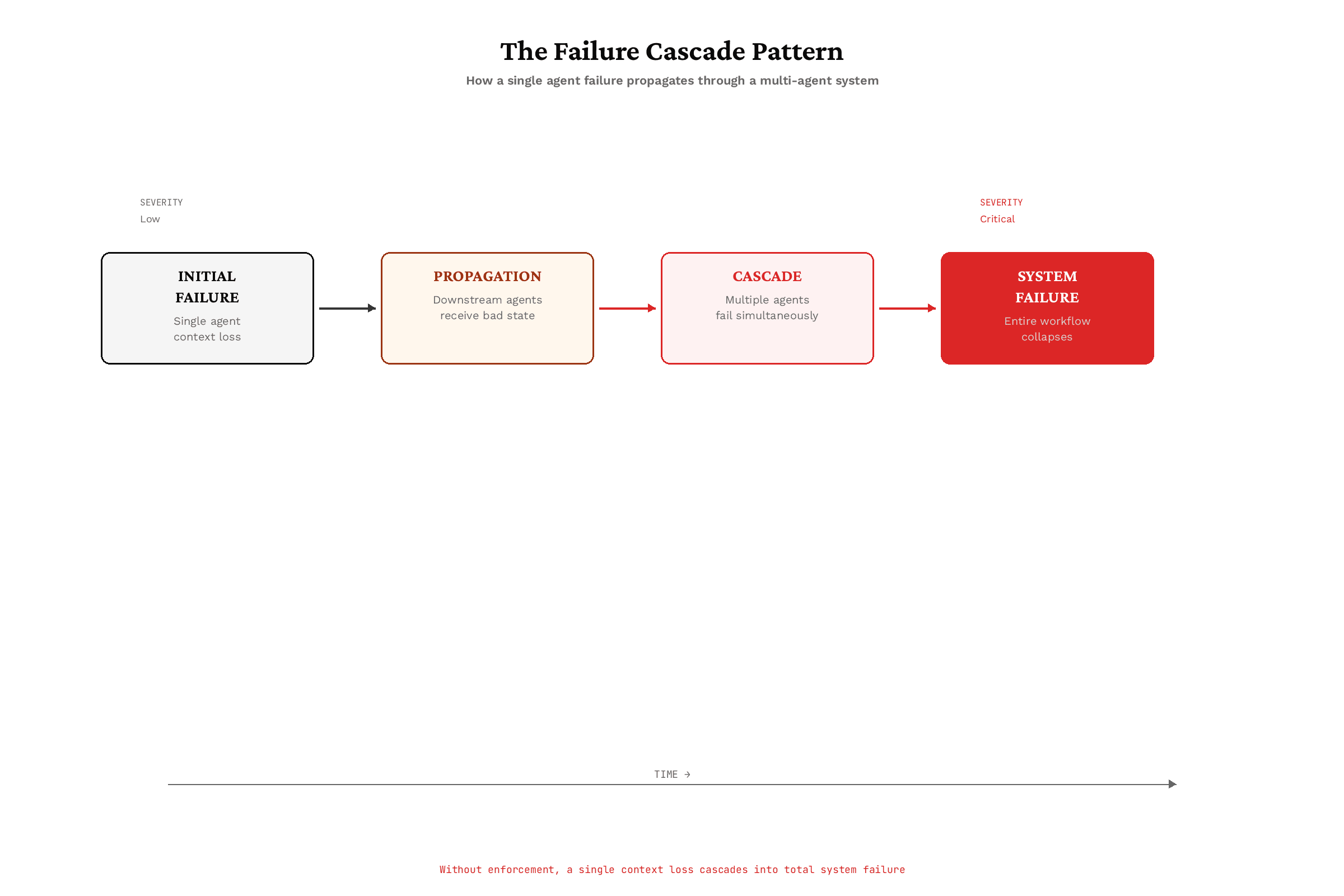
Cascading Failures
One agent fails, causing dependent agents to fail. System collapse.
**Prevention:** Circuit breakers and graceful degradation.
Infinite Loops
Agent enters a loop and never exits. Burns resources indefinitely.
**Prevention:** Iteration limits and timeout enforcement.
Context Overflow
Agent accumulates too much context and exceeds token limits. Crashes mid-task.
**Prevention:** Context pruning and long-term memory systems.
Unauthorized Access
Agent accesses resources it shouldn't. Security breach or data corruption.
**Prevention:** Behavioral contracts with access control enforcement.
Silent Failures
Agent fails but doesn't report it. System thinks task completed successfully.
**Prevention:** Explicit success/failure reporting and health checks.
Version Mismatch
Agents use incompatible protocol versions. Communication breaks down.
**Prevention:** Versioned contracts with backward compatibility.
The Success Patterns
The study also identified what successful multi-agent systems do differently:
1. Observability First
Successful systems invest heavily in monitoring and logging. You can't fix what you can't see. Build dashboards before you build agents.
2. Contracts Everywhere
Every agent has explicit contracts. No implicit assumptions. No "it should just work." Formal specifications prevent 80% of bugs.
3. Graceful Degradation
When things fail (and they will), the system degrades gracefully. Partial functionality beats total failure. Design for resilience, not perfection.
4. Incremental Deployment
Don't deploy 50 agents at once. Start with 3-5. Add more as you understand the system. Complexity compounds—manage it carefully.
5. Human Escalation Paths
Agents should know when they're stuck and escalate to humans. Autonomy doesn't mean isolation. Build escape hatches.
How ArmadaOS Applies These Lessons
ArmadaOS was designed with these failure modes in mind. Here's how we prevent them:
Resource Contracts
Every agent has hard resource limits. Prevents exhaustion and infinite loops.
MCP Orchestration
Centralized state management prevents inconsistency and coordination deadlocks.
Reliable Messaging
A2A protocol with acknowledgments ensures no message loss.
Circuit Breakers
Agents fail independently without cascading. System degrades gracefully.
Observability Dashboard
Real-time visibility into agent status, resource usage, and system health.
Frequently Asked Questions
How do I prevent my multi-agent system from crashing?
Implement the top 3 preventions: resource contracts, centralized state management, and graceful degradation. These address 70% of failure modes.
What's the most common mistake in multi-agent systems?
Deploying without observability. You can't debug what you can't see. Build monitoring first, agents second.
How many agents should I start with?
3-5 agents maximum for your first deployment. Learn the failure modes at small scale before scaling up. Complexity is non-linear.
Should I use synchronous or asynchronous communication?
Asynchronous with reliable queues. Synchronous communication creates tight coupling and deadlock risks. Async is harder to implement but more resilient.
How do I handle agent failures in production?
Circuit breakers and retry logic. When an agent fails, isolate it, retry with exponential backoff, and escalate to humans if retries fail. Never let one failure cascade.
What metrics should I monitor?
Resource usage per agent, message queue depth, task completion rate, error rate, and response time. Alert on anomalies, not thresholds.
Source Research
This analysis is based on the paper "Large-Scale Study of Multi-Agent Systems Development" analyzing 42,000 commits, published on arXiv.
Read Full Paper →