
Testing shows the presence of bugs. Formal verification proves their absence.
The Trust Problem
How do you know your AI agents will behave correctly? Most companies rely on testing. But testing only shows what you thought to test.
With multi-agent systems, the state space explodes. You can't test every possible interaction. You can't anticipate every edge case. You're deploying systems you can't fully verify.
The paper "Veri-Sure: Contract-Aware Multi-Agent Framework with Formal Verification" introduces a different approach: **mathematical proof** that agents will behave correctly.
What Is Formal Verification?
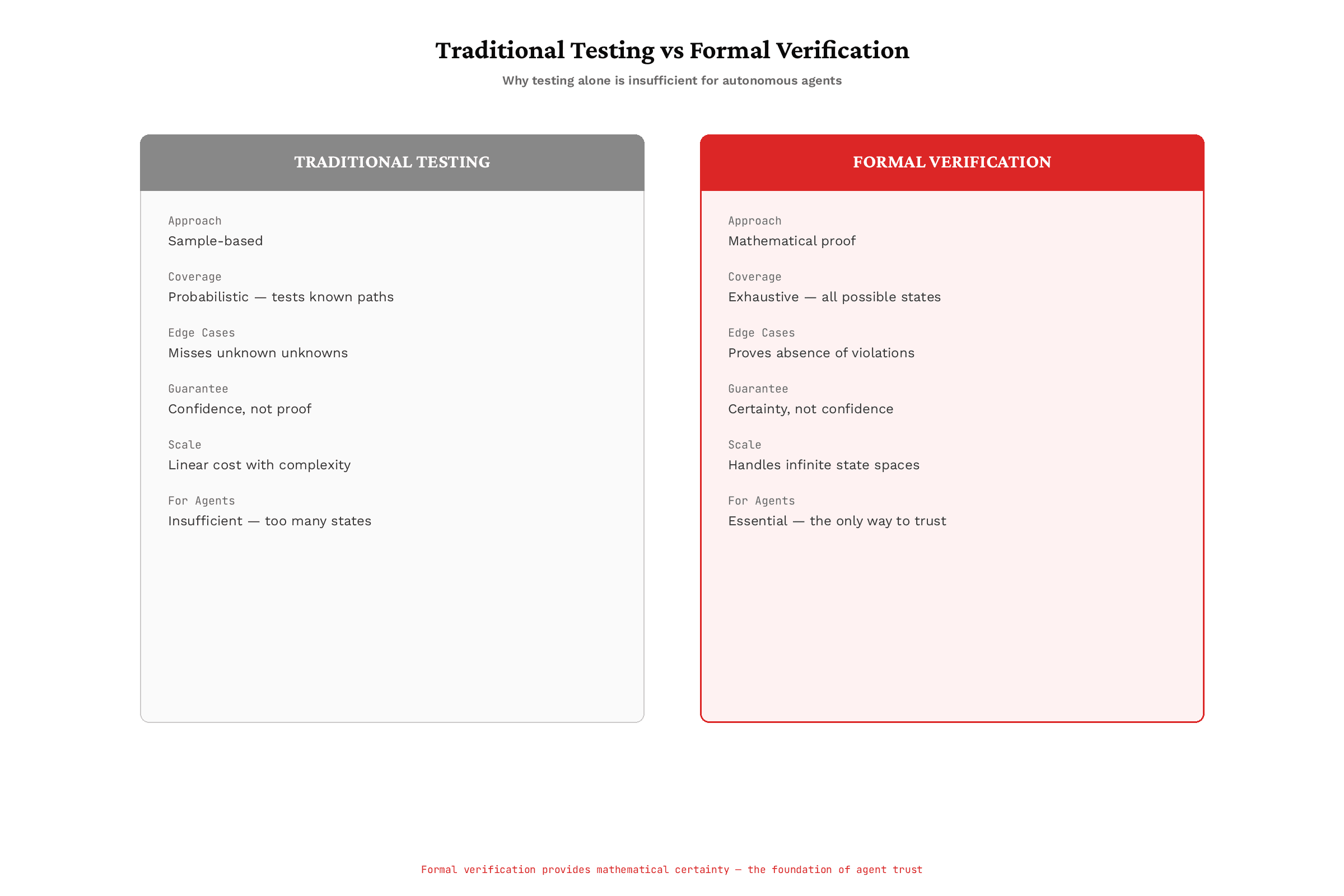
Formal verification uses mathematical logic to prove system properties. Instead of testing scenarios, you prove theorems.
Traditional Testing
"We tested 1000 scenarios and they all passed."
Confidence: High for tested scenarios. Unknown for untested scenarios.
Formal Verification
"We proved mathematically that this property holds for ALL possible scenarios."
Confidence: Absolute. If the proof is correct, the system is correct.
This is the difference between "probably works" and "provably works."
The Veri-Sure Framework
Veri-Sure combines agent contracts with formal verification. Here's how it works:
Define Contracts
Each agent has a formal contract specifying what it does, what resources it uses, and what guarantees it provides.
Express Properties
Write the properties you want to verify in formal logic. "Agent never exceeds budget." "Agent always terminates." "Agent never deletes data without approval."
Generate Proofs
The verification engine generates mathematical proofs that the contracts guarantee the properties.
Deploy with Confidence
If the proofs check out, you have mathematical certainty. No testing required.
What Can You Verify?
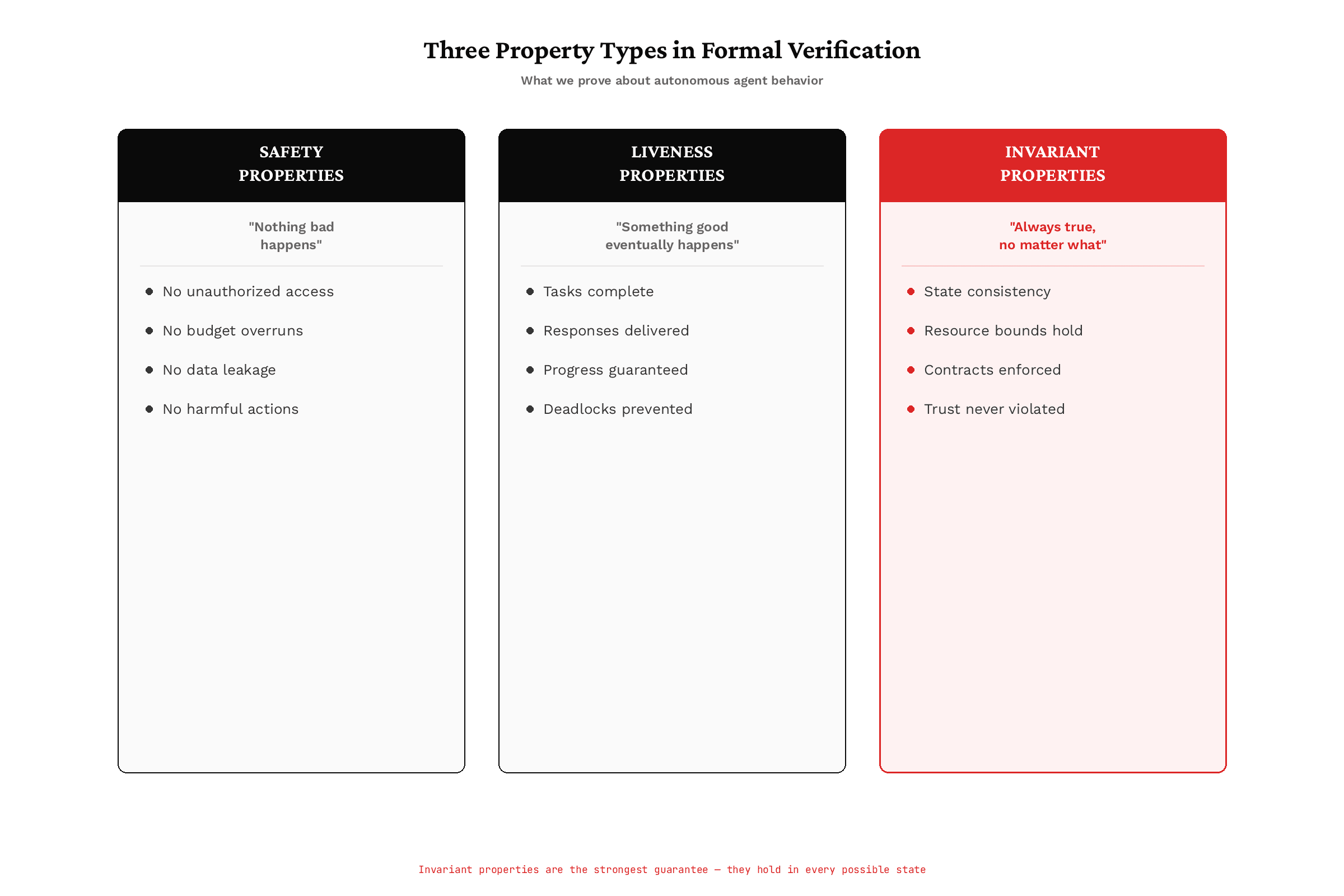
Formal verification works for specific properties. Here are the most valuable ones for multi-agent systems:
Safety Properties
"Bad things never happen."
- Agent never exceeds resource limits
- Agent never enters deadlock
- Agent never violates access controls
- Agent never produces invalid output
Liveness Properties
"Good things eventually happen."
- Agent eventually completes its task
- Agent eventually responds to requests
- Agent eventually releases resources
- Agent eventually reaches a decision
Invariant Properties
"Certain conditions always hold."
- Total resource usage never exceeds system capacity
- Data consistency is maintained across agents
- Security policies are always enforced
- State transitions are always valid
Why Shadow Needs This
Shadow, ArmadaOS's security and compliance agent, uses formal verification to guarantee safety properties.
When Shadow reviews an agent's actions, it doesn't just test—it **proves** that the actions satisfy security policies. This aligns with PEK's vision of mathematical certainty.
Examples of what Shadow verifies:
- **Access control:** Proves that agents only access authorized resources
- **Data handling:** Proves that sensitive data is never exposed
- **Resource limits:** Proves that agents stay within budgets
- **Compliance:** Proves that actions satisfy regulatory requirements
Frequently Asked Questions
Is formal verification practical for real systems?
Yes, for specific properties. You can't verify "the agent is intelligent" (too vague), but you can verify "the agent never exceeds its budget" (precise). Focus on safety-critical properties.
How long does verification take?
Seconds to minutes for most properties. The verification happens once when you define the contract, not at runtime. After that, the system enforces the proven properties automatically.
Do I need to understand formal logic?
Not for basic use. The Veri-Sure framework provides templates for common properties. For custom properties, yes—you'll need formal methods expertise. This is where Shadow helps.
What if the proof fails?
Then you've found a bug before deployment. The verification engine shows you the counterexample—a scenario where the property doesn't hold. Fix the contract or the agent, then re-verify.
Can I verify AI behavior?
You can't verify "the AI makes good decisions" (subjective), but you can verify "the AI follows its contract" (objective). Verification works for constraints, not intelligence.
Is this overkill for most applications?
For toy projects, yes. For production systems handling money, data, or critical decisions? No. Formal verification is insurance. You hope you don't need it, but you're glad it's there.
Getting Started with Verification
To add formal verification to your multi-agent system:
Identify Critical Properties
What MUST be true for your system to be safe? Start with 3-5 properties. Resource limits, access control, data integrity.
Formalize Contracts
Write agent contracts that express these properties. Use the Veri-Sure contract language or similar formal specification language.
Run Verification
Use a verification tool (Veri-Sure, TLA+, Coq) to generate proofs. If proofs fail, fix contracts and retry.
Enforce at Runtime
Integrate contract enforcement into your orchestration layer. The proven properties become runtime checks.
Iterate
As you add agents or change contracts, re-verify. Make verification part of your deployment pipeline.
Source Research
This analysis is based on the paper "Veri-Sure: Contract-Aware Multi-Agent Framework with Formal Verification" published on arXiv.
Read Full Paper →